
Multi-Location Rentals: Navigating Land Use Laws
May 4, 2026 · 13 min read
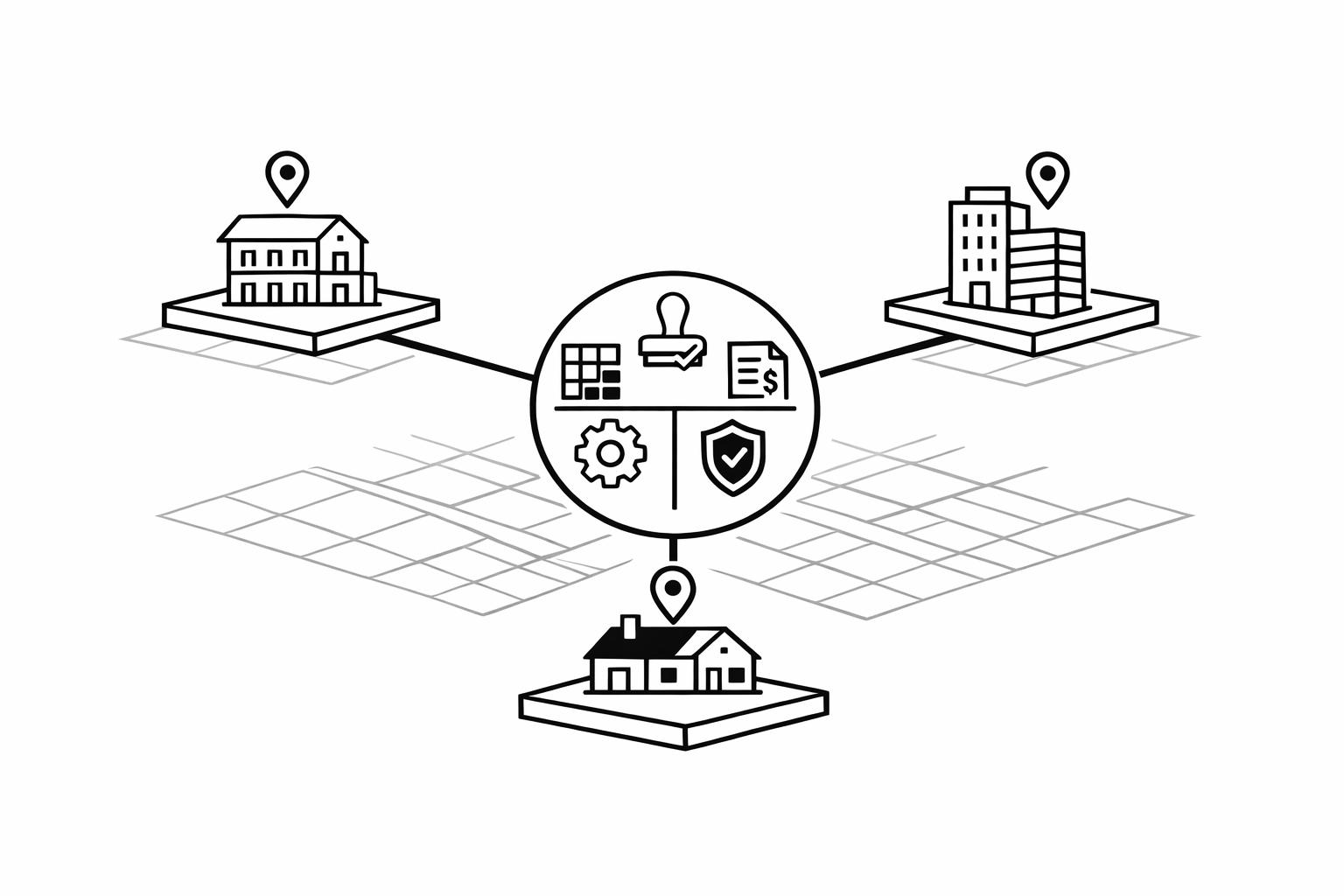
Multi-Location Rentals: Navigating Land Use Laws
Managing rentals across different locations can be tricky due to varying land use laws and zoning regulations. Here's what you need to know:
- Zoning laws differ by location: Rules can vary even between neighboring cities. For example, non-hosted short-term rentals in San Francisco are capped at 120 nights annually, while New York City allows only two guests for hosted rentals under Local Law 18.
- Compliance is mandatory: Missing permits or violating zoning laws can result in fines up to $5,000 or more. In Nashville, a permit lapse can lead to $500 daily fines.
- Regulations depend on property type: Whether a rental is owner-occupied, hosted, or unhosted can affect its legal requirements.
- State vs. local rules: Some states, like Florida, require state licenses but also enforce municipal registration. Others, like Oregon, override local zoning to allow more housing options.
- Tools and strategies help: Use compliance checklists, centralized tools, and automated reminders to track permits, taxes, and deadlines.
Navigating these laws is key to avoiding penalties and ensuring smooth operations across multiple locations.
::: @figure Multi-Location Rental Compliance: Key Regulations and Penalties by City{Multi-Location Rental Compliance: Key Regulations and Penalties by City} :::
Understanding Zoning and Land Use Laws
What Are Zoning Laws?
Zoning is a tool that local governments use to regulate how land is used within their jurisdictions. This is done by dividing areas into districts and assigning specific rules for each district [5].
"Zoning is a police-power regulatory tool through which local governments divide their jurisdictions into districts and prescribe the categories of land use." - National Property Authority [5]
These zoning districts are marked on maps and come with rules that outline what is allowed, conditionally allowed, or outright prohibited. For instance, designations like R-1 or C-2 indicate whether land is zoned for residential, commercial, or industrial purposes, along with specific activities permitted in each category.
Zoning laws define three main types of land use:
- Permitted uses: Activities allowed without any special approval.
- Conditional uses: Activities allowed only after meeting certain requirements, often involving public hearings.
- Prohibited uses: Activities explicitly banned in that zone.
For rental businesses, understanding these distinctions is crucial. For example, a property zoned as residential might restrict certain rental activities, while a mixed-use zone might allow them.
Common Zoning Restrictions
Zoning laws often include dimensional standards - like setbacks, building height limits, lot coverage, and Floor Area Ratio (FAR) - which directly impact how a property can be used [5][6]. These rules may determine whether you can add parking spaces, expand storage areas, or install necessary equipment.
In some areas, overlay districts add another layer of restrictions. These districts, such as historic preservation zones or flood hazard areas, impose additional requirements beyond the base zoning rules [5]. For instance, properties located in FEMA-designated flood zones might need extra precautions before they can be used for rentals.
Short-term rentals are often subject to stricter regulations. Many cities limit the number of rental days for non-hosted properties, require special permits, or ban such rentals entirely in residential zones [6]. Take Chattanooga, Tennessee, as an example: new short-term rentals in residential zones are prohibited unless the owner lives on-site. Rentals are generally allowed only in commercial districts that permit hotels, and properties rezoned from residential to commercial must wait 18 months before applying for a rental permit [4].
Existing rental operations may sometimes be "grandfathered in" when new restrictions are introduced. For example, in Tennessee, operators with permits issued before Nashville's BL2017-608 ordinance were protected under the Tennessee Short-Term Rental Unit Act. However, these protections can be lost if a rental business shuts down for 30 continuous months or if the operator violates local laws three times [4].
How Land Use Laws Vary by Location
Because zoning authority is delegated to local governments through state enabling acts, there are around 39,000 unique zoning ordinances across the U.S. [5]. A zoning designation like "R-2" might allow two-family homes in one city but only permit accessory units in another [5].
Sometimes, state laws override local zoning rules. For example, Oregon's House Bill 2001 requires cities with populations over 10,000 to allow "middle housing" options - like duplexes and triplexes - in areas previously zoned for single-family homes [5]. Similarly, California mandates that Accessory Dwelling Units (ADUs) must be allowed in single-family zones, while New York City enforces stricter rules that make ADUs much harder to implement [6].
Geographic and local priorities also influence zoning. Coastal towns, for instance, may enforce stricter rules to address hurricane risks and environmental concerns, while urban areas might focus on density and parking requirements [6]. Before expanding a rental operation to a new area, it’s essential to review the local zoning ordinances, check the zoning map, and request a zoning verification letter from the planning department to confirm what’s permitted [5][6].
These variations highlight the importance of understanding local zoning laws to ensure compliance when managing rental properties.
How Do R-1 And R-2 Zoning Affect Rental Properties? - Rental Property Gurus
::: @iframe https://www.youtube.com/embed/3vLG8As1LG4 :::
Federal, State, and Local Requirements for Rental Businesses
Rental businesses operating in multiple locations face a complex web of regulations. These include federal laws that apply nationwide, state-specific rules that vary widely, and local ordinances that can differ even between neighboring cities. Successfully navigating these layers is essential to staying compliant.
Federal Regulations That Affect Rentals
Federal laws create a baseline for all rental businesses. The [Fair Housing Act](https://www.justice.gov/crt/fair-housing-act-1) prohibits discrimination based on protected characteristics, while the [Americans with Disabilities Act](https://www.ada.gov/law-and-regs/ada/) (ADA) enforces accessibility standards and fire safety compliance for commercial or lodging properties [1].
Rental income must be reported to the IRS under 26 USC §61, and the IRS 14-Day Rule (26 USC §280A) allows tax-free rental income if the property is rented for 14 days or fewer annually, though local permitting is still required [1]. Additionally, for properties built before 1978, the [EPA Lead Disclosure Rule](https://www.epa.gov/lead/lead-based-paint-disclosure-rule-section-1018-title-x) mandates that landlords disclose known lead-based paint hazards to tenants before leasing [1]. These federal laws provide a foundation for compliance across all jurisdictions.
State-Level Requirements
State laws build on federal regulations, tailoring requirements to local contexts. For instance, some states, like Arizona, prevent local governments from banning short-term rentals outright, as seen in ARS §9-500.39 [1]. On the other hand, states like California and New York empower cities to impose stricter rules [1].
In Florida, rental businesses must obtain a state license through the Division of Hotels and Restaurants (Chapter 509), but this doesn’t replace local registration requirements. By the early 2020s, over 200 U.S. cities had implemented specific registration or licensing rules for short-term rentals, despite at least 15 states enacting preemption laws to limit outright bans [2]. To streamline compliance, leading booking platforms have partnered with jurisdictions in at least 18 states, automating tax collection and verifying permit numbers [1].
Local Zoning and Permit Requirements
Local governments enforce detailed rules that address community-specific concerns. Zoning laws determine whether rentals are allowed, conditionally permitted, or prohibited in specific areas. Cities also regulate issues like noise, parking, trash management, and occupancy limits [1][2]. Many municipalities require annual registration, with fees ranging from under $100 to over $500.
For example, in December 2025, Parkersburg, West Virginia, passed an ordinance requiring rental property registration and inspections, supported by a $25 annual business license fee per unit [7]. Similarly, New York City’s Local Law 18, implemented in 2023, mandates host registration with the Mayor’s Office of Special Enforcement and requires hosts to be present during guest stays, effectively banning whole-unit short-term rentals in most residential buildings [1].
Before expanding into a new location, it’s essential to check the property’s zoning classification, review any homeowners association rules, and confirm all necessary permits with local planning offices. For businesses managing multiple properties, centralized compliance tracking is key to avoiding expired licenses and costly penalties. Implementing automated access solutions can further simplify management across these diverse jurisdictions. These layered requirements set the stage for discussing strategies to maintain compliance across multiple locations.
How to Achieve Multi-Location Compliance
Managing compliance across multiple rental locations can feel like navigating a maze of regulations. But with a structured process, you can turn this challenge into something manageable and repeatable. The key lies in creating standardized workflows that work across different markets.
Creating a Compliance Checklist
A compliance checklist breaks the process into five clear steps: Scan (identify state-level rules), Drill Down (review local and HOA regulations), Map (summarize compliance requirements in a single document), Act (complete registrations and secure insurance), and Document (store all records centrally) [9].
Your checklist should include critical items like business licenses, Transient Occupancy Tax (TOT) registration, zoning confirmations, HOA or condo rules, safety certifications, and insurance endorsements [9]. For zoning, review the local ordinance to ensure the property’s use aligns with current rules. Be sure to check for "legal nonconforming" status - essentially grandfathered rights that allow a property to operate under older zoning rules. Keep in mind, these rights can expire if the property remains unused for one to two years [3].
"Treat mid-term rental legal compliance as part of your ops, not a legal footnote." – MiniStays [9]
Adding a "local compliance clause" to lease agreements can also help. This clause ensures tenants agree to follow building rules and local ordinances, reducing potential disputes later on [9].
Once your checklist is in place, digital tools can make managing compliance across multiple locations much easier.
Using Centralized Tools to Manage Compliance
Centralized digital tools are game-changers for handling multi-location compliance. They streamline tasks like tracking renewal dates, tax schedules, and permit requirements. Market Folders, for instance, can serve as a hub for storing licenses, certificates, and bylaws, making it easier to manage operations as you expand [9].
Automated reminders are another must-have. They help you stay on top of tax filings - whether monthly or quarterly - and ensure you don’t miss permit renewal deadlines, which can lead to penalties [9]. For rental businesses running 24/7 contactless operations, platforms like Lockii offer built-in compliance tracking, automated documentation, and audit logs. These features are invaluable during audits or insurance claims when you need to produce records quickly.
In Colorado, a Land Use and Housing Implementation Portal introduced in June 2025 under HB24-1152 allows jurisdictions to submit compliance reports. This portal organizes forms by law, deadlines, and completion status, eliminating the need for endless calls to local agencies [8].
Working with Local Authorities and HOAs
While checklists and digital tools are essential, direct collaboration with local authorities and HOAs is equally important. Pre-application meetings with municipal planning staff can boost your chances of securing permits or variances by up to 40% [10]. If you're applying for a zoning variance, prepare detailed documentation showing the unique property constraints or "hardship" that justifies your request. Professional plans and studies, such as traffic impact assessments, can strengthen your case [10].
For HOA-governed properties, remember that private land-use covenants often have stricter controls than zoning laws. These covenants are enforced through contracts and usually can’t be overridden by standard zoning permissions. Before starting operations, secure a written waiver or agreement with the HOA board. In states like Colorado, while HOAs can’t outright ban ADUs, they can impose "reasonable restrictions" as long as they don’t significantly increase costs [8].
If you receive a compliance notice, immediately log the date and agency, pause bookings if needed, and consult a code officer or local attorney to understand the next steps. Many resort markets now require rental owners to register a local point of contact for immediate code enforcement issues. Ignoring this requirement can escalate violations [10].
Common Compliance Mistakes and How to Avoid Them
Expanding rental operations across multiple locations often brings compliance challenges, even with solid systems in place. Knowing where mistakes happen can help you sidestep hefty fines and operational disruptions.
Missing Permit Renewals
Permit renewals are a common stumbling block, even when centralized compliance tools are in use. Managing properties in multiple jurisdictions makes it easy to miss annual reporting deadlines. For instance, New York City's Local Law 97 requires greenhouse gas emissions reports by May 1 each year. Missing this deadline can result in fines and civil penalties. Beyond that, exceeding emissions limits adds a penalty of $268 for every metric ton of carbon dioxide equivalent over the threshold [13].
To avoid this, consider using automated reminders for all renewable compliance deadlines. Tools like Lockii are designed for multi-location operations, offering built-in tracking for permits and licenses, along with automated alerts to help you stay on top of requirements.
But permit renewals are just one piece of the puzzle. Misunderstanding zoning restrictions is another frequent - and costly - error.
Misunderstanding Zoning Restrictions
Zoning issues often arise when businesses assume their rental use is automatically permitted based on general zoning classifications. However, many uses require additional approvals, like a Special Use Permit or Site Plan Review, to ensure operations won’t negatively impact the neighborhood with noise, traffic, or other disruptions [11].
Overlay zones add another layer of complexity. These zones impose extra restrictions for areas like flood zones, historic districts, or airport approach areas. For example, in New York City's Special Mixed Use Districts, new residential units must meet specific noise attenuation standards, such as providing 35dB(A) window wall attenuation to maintain interior noise levels of 45dB(A) or less [12].
"One of the most powerful tools in the local government arsenal is the power to regulate the physical development of the municipality." – New York Department of State [11]
To avoid zoning pitfalls, always contact the local planning department before acquiring a property. Confirm permitted uses, check for overlay zones, and inquire about any pending changes. Reviewing the municipality’s Official Map can also help you ensure your site doesn’t interfere with future plans for streets, parks, or drainage systems [11].
Failing to Follow Local Ordinances
Local ordinances often vary widely between jurisdictions, creating another compliance challenge. These rules can include performance standards for noise, vibration, and lighting, which may apply even if your primary use is permitted [11]. Violating these thresholds can lead to fines or forced operational changes.
Another common issue arises in mixed-use buildings. For example, commercial or manufacturing activities are typically restricted to lower floors beneath residential units unless specific environmental and access requirements are met. Ignoring these vertical use restrictions could force you to relocate or shut down entirely [12].
Lease agreements can also become a point of contention. When New York City's Local Law 97 took effect, disputes arose between landlords and tenants over who should bear the cost of expensive decarbonization retrofits. As Joseph P. Heins, Special Counsel at Phillips Lytle, explained:
"Landlords typically seek to shift the expense of LL97 compliance to their tenants... particularly in light of the potentially significant expense that owners may incur" [13].
To avoid such disputes, consider adding "green lease provisions" that clearly outline how compliance costs will be shared. This proactive step can help prevent disagreements and ensure smoother operations.
Conclusion
Managing land use laws across multiple rental locations isn't just a box to check - it's the backbone of growing your business responsibly. With 18 states legalizing ADUs and over 100 cities removing parking minimums by 2026, zoning regulations are evolving at a breakneck pace [3]. Staying informed and proactive ensures your investments remain secure and your revenue streams uninterrupted.
The financial consequences of non-compliance can be steep. For instance, missing a permit renewal or misunderstanding zoning rules in New York City can lead to fines as high as $5,000 per violation. Tackling zoning issues through formal rezoning can cost anywhere from $5,000 to over $50,000, with timelines stretching from 6 to 18 months - and no guarantee of success [2][3]. These challenges only grow when managing properties across various jurisdictions, each with its own set of federal, state, and local regulations.
One way to stay ahead of these challenges is by using centralized tools designed to simplify compliance. Tools like Lockii are tailored for multi-location operations, offering features like automated permit tracking, renewal reminders, and audit logs to monitor compliance across all your properties. This approach lightens the administrative load, helping you manage renewal cycles, tax responsibilities, and local ordinances more effectively - allowing your business to grow without unnecessary setbacks.
Beyond avoiding fines, staying compliant also enhances your property's value and attracts tenants who value well-run, legally sound operations. Take Minneapolis as an example: zoning reforms there contributed to a 4% drop in rents between 2019 and 2024, even as national rents surged by 22%, showing how regulatory changes can directly shape market trends [3].
As one industry expert puts it, "The ability to adapt and stay informed is not just important - it's the cornerstone of flourishing in this vibrant short-term rental market" [14]. By focusing on compliance from the start, leveraging the right tools, and maintaining communication with local authorities, you can build a rental business that grows seamlessly across multiple locations without the constant worry of legal hurdles.
FAQs
::: faq
How do I quickly confirm if a property can be rented in a specific zone?
To find out whether a property can be rented in a particular area, start by checking local zoning maps and codes to see what activities are permitted. For precise information, reach out to the municipal or county zoning office or use official zoning lookup tools. They can clarify whether rental activities are allowed and let you know if any special permits or variances are needed. This step helps ensure you're following zoning rules before moving forward. :::
::: faq
What permits and taxes are required in each city before starting rentals?
Regulations for short-term rentals can differ significantly depending on the city. You’ll often need to secure permits like a short-term rental license or a business license and ensure your property complies with local zoning laws.
Many cities also require hosts to collect occupancy or lodging taxes from their guests and remit them to the appropriate local authorities. Skipping these steps could lead to fines or other penalties, so it’s essential to stay on top of the rules.
To make things easier, consider using tools like [Lockii](https://www.lockii.app/), which can simplify the process of managing compliance, especially if you operate in multiple locations. :::
::: faq
How can I track renewals and avoid fines across multiple locations?
To keep track of renewals and steer clear of fines across multiple locations, set up a centralized system for managing licenses and permits. Regularly audit your records to confirm all documents are current, and keep a well-organized log of renewal deadlines.
This method makes it easier to monitor expiration dates, avoid missed renewals, and stay compliant - minimizing the chances of fines or interruptions to your operations across different locations. :::